Pilot whales — Ngāwī coast and Mangatoetoe Beach, Cape Palliser, South Wairarapa — 5 November 2026Grindwale — Küste bei Ngāwī und Mangatoetoe Beach, Cape Palliser, South Wairarapa — 5. November 2026
Overnight on 4–5 November 2026, a large group of pilot whales came ashore on the rocky, boulder-strewn coast south of Ngāwī, near Cape Palliser, the southernmost point of New Zealand's North Island. A local resident heard about it from a commercial pāua diver at about 9 am on Thursday 5 November and counted about 20 whales, with reports of 20 or more further along the coast [1]. The Department of Conservation (DOC) says reports began arriving at about 9:30 am and an operations team was mobilised by about 11 am [1]. DOC later said there were two pods [3]; locals named at least three sites [16] spread over about a kilometre [2].
Local iwi, residents and volunteers were in the water from around midday, holding whales up and pouring water over them with buckets and towels [2][4][13]. At about midday, Project Jonah posted that "No further help is needed at this stage" [10], and a regional volunteer group asked people to stop coming [15]. A trained rescue group that arrived at 2 pm says it had been told not to come, that "nothing was being done", and that most of the whales were already dead [17].
The only official numbers are small and they contradict each other. DOC said four whales were alive in the first pod [9], then that two had been refloated [2][4], while its acting operations manager told the Wairarapa Times-Age that only one had been [1]. DOC said a second pod "is currently being assessed" [3] and has not reported on it since. Media and eyewitness counts of stranded whales range from 14 to 50 [4][6][7][8][23]. By 2 am NZ time on Friday, 1News was reporting at least 30 dead [3]. One UK charity reports that all of the whales died, including the two that were refloated [23].
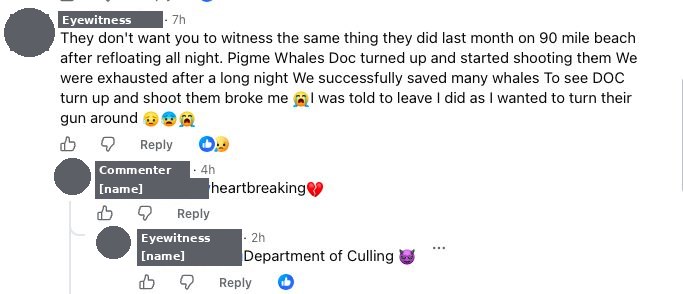
DOC has not said what happened to the four whales it reported alive, what happened to the second pod, whether any whale was euthanised or shot, or whether any necropsies will be done. One month earlier, on Ninety Mile Beach, 11 pygmy killer whales were shot the morning after the public was told to "stay home" [26].
During the night before the stranding, the Australian research ship RV Investigator was approaching its scheduled Wellington port call [24]. It carries powerful multibeam mapping sonars. A social media post says it rounded Cape Palliser that night [22]. Nobody has yet established where the ship was, or whether its sonars were running.
In der Nacht vom 4. auf den 5. November 2026 strandete eine große Gruppe von Grindwalen an der felsigen, mit Geröll übersäten Küste südlich von Ngāwī nahe Cape Palliser, dem südlichsten Punkt der Nordinsel Neuseelands. Ein Anwohner erfuhr gegen 9 Uhr am Donnerstag, 5. November, von einem kommerziellen Pāua-Taucher davon und zählte etwa 20 Wale; weitere 20 oder mehr sollten weiter entlang der Küste liegen [1]. Laut Department of Conservation (DOC) gingen gegen 9:30 Uhr erste Meldungen ein, und gegen 11 Uhr wurde ein Einsatzteam mobilisiert [1]. Später sprach das DOC von zwei Gruppen [3]; Einheimische nannten mindestens drei Fundorte [16], verteilt über etwa einen Kilometer [2].
Lokale Iwi, Anwohner und Freiwillige standen ab etwa Mittag im Wasser, stützten Wale und begossen sie mit Eimern und Handtüchern [2][4][13]. Gegen Mittag erklärte Project Jonah: „Derzeit wird keine weitere Hilfe benötigt" [10], und eine regionale Freiwilligengruppe bat die Menschen, nicht mehr zu kommen [15]. Eine ausgebildete Rettungsgruppe, die um 14 Uhr eintraf, berichtet, man habe ihr gesagt, sie solle nicht kommen, es sei „nichts getan" worden und die meisten Wale seien bereits tot gewesen [17].
Die einzigen offiziellen Zahlen sind klein und widersprechen sich. Das DOC meldete vier lebende Wale in der ersten Gruppe [9], dann zwei erfolgreich zurückgeführte [2][4], während die stellvertretende Einsatzleiterin der Wairarapa Times-Age sagte, es sei nur einer gewesen [1]. Die zweite Gruppe werde „derzeit begutachtet" [3]; seitdem gibt es dazu keine Angaben. Die Zahl der gestrandeten Wale liegt je nach Medien- und Augenzeugenbericht zwischen 14 und 50 [4][6][7][8][23]. Bis 2 Uhr Ortszeit am Freitag meldete 1News mindestens 30 Tote [3]. Eine britische Organisation berichtet, alle Wale seien gestorben, auch die beiden zurückgeführten [23].
Das DOC hat nicht gesagt, was mit den vier lebend gemeldeten Walen geschah, was aus der zweiten Gruppe wurde, ob Wale eingeschläfert oder erschossen wurden und ob Nekropsien stattfinden. Einen Monat zuvor wurden am Ninety Mile Beach 11 Zwergschwertwale am Morgen erschossen, nachdem die Öffentlichkeit aufgefordert worden war, „zu Hause zu bleiben" [26].
In der Nacht vor der Strandung näherte sich das australische Forschungsschiff RV Investigator seinem planmäßigen Hafenaufenthalt in Wellington [24]. Es trägt leistungsstarke Fächerecholote zur Meeresbodenkartierung. Ein Social-Media-Beitrag besagt, es habe in jener Nacht Cape Palliser umrundet [22]. Bislang hat niemand geklärt, wo sich das Schiff befand und ob seine Sonare in Betrieb waren.
Seventeen hours after the first report, the public still cannot answer the most basic questions about this stranding. Every box below is either a range built from contradictory sources or a blank that only DOC can fill. Under GWRA Principle V (total transparency), every one of these figures would be published as the response unfolds.
Siebzehn Stunden nach der ersten Meldung kann die Öffentlichkeit die grundlegendsten Fragen zu dieser Strandung noch immer nicht beantworten. Jedes Feld unten ist entweder eine Spanne aus widersprüchlichen Quellen oder eine Lücke, die nur das DOC füllen kann. Nach GWRA-Prinzip V (vollständige Transparenz) würde jede dieser Zahlen laufend veröffentlicht.
| SourceQuelle | Time (NZDT, 5 Nov)Zeit (NZDT, 5. Nov.) | StrandedGestrandet | AliveLebend | RefloatedZurückgeführt | Dead / fateTot / Schicksal |
|---|---|---|---|---|---|
| Andrew Sim, resident [1] | ~9 am | ~20, + "20 or more" further on | "some"„einige" | — | "some" dead„einige" tot |
| DOC, Facebook [9] | 11:26 am–12:26 pm | "a pod"„eine Gruppe" | 4 | — | — |
| Project Jonah, Facebook [10] | 11:51 am–12:51 pm | at least 20mindestens 20 | 4 | — | — |
| DOC via 1News [3] | 12:42 pm | 2 pods2 Gruppen | 4 in first pod; second pod "being assessed"4 in erster Gruppe; zweite „wird begutachtet" | — | — |
| Alex Beijen, ex-mayor, via Stuff [2] | afternoonNachmittag | dozens over ~1 km; 20 at Mangatoetoe aloneDutzende auf ~1 km; 20 allein am Mangatoetoe | "difficult to estimate"„schwer zu schätzen" | ~5 | "many of them dead"„viele tot" |
| DOC statement via Stuff / Reuters [2][4] | afternoonNachmittag | ~20 | — | 2 | — |
| Ariana Hawera, DOC, via Post [1] | afternoon (updated)Nachmittag (aktualisiert) | — | — | 1 | "continued to be monitored"„wird weiter beobachtet" |
| Eyewitness on the beachAugenzeugin am Strand [19] | 3:33–4:33 pm | ~20 | — | 4 | — |
| Nikki Carmichael, DOC medic, via AFP [7] | afternoonNachmittag | at least 14mindestens 14 | — | 1 | "a lot" dead; some washed out to sea„viele" tot; einige ins Meer gespült |
| RNZ locals via Reuters [4] | 8:00 pm | up to 50bis zu 50 | "on their last breaths"„in den letzten Atemzügen" | 2 (DOC) | "most succumbed"„die meisten erlagen" |
| Eyewitness in the waterAugenzeugin im Wasser [13] | 8:15–9:15 pm | — | — | "quite a few out"„ziemlich viele raus" | "even if we managed to save one"„selbst wenn wir nur einen retten konnten" |
| Marine Connection (UK) [23] | 9:36–10:36 pm | ~50 | — | 2 | all died, including both refloatedalle tot, auch beide zurückgeführten |
| HUHANZ [21] | 10:22–11:22 pm | ~30 | — | — | "nothing they could do"„nichts zu machen" |
| 1News (updated headline) [3] | by 1:59 am, 6 Novbis 1:59 Uhr, 6. Nov. | "dozens"„Dutzende" | still "four alive in the first pod"weiterhin „vier lebend in der ersten Gruppe" | — | at least 30 deadmindestens 30 tot |
No source in our files reports a shooting at Ngāwī, and no source reports that none took place. DOC has said nothing at all about euthanasia in this event. After Ninety Mile Beach in October, when 11 whales were shot within hours [26], that silence is not reassuring. The question is put to DOC directly in the letter below.
Keine Quelle in unseren Unterlagen berichtet von Erschießungen in Ngāwī, und keine Quelle berichtet, dass keine stattfanden. Das DOC hat sich zu Euthanasie bei diesem Ereignis überhaupt nicht geäußert. Nach dem Ninety Mile Beach im Oktober, als 11 Wale innerhalb weniger Stunden erschossen wurden [26], ist dieses Schweigen nicht beruhigend. Die Frage wird dem DOC im Schreiben unten direkt gestellt.
The CSIRO research vessel RV Investigator is due in Wellington for a port call starting 5 November, between the two legs of a voyage along 170°W [24]. A widely shared post says it "rounded Cape Palliser overnight and subsequently docked in Wellington" [22]. Its exact track and sonar use are not yet known.
Das CSIRO-Forschungsschiff RV Investigator soll ab dem 5. November zwischen zwei Fahrtabschnitten entlang 170°W in Wellington anlegen [24]. Ein vielfach geteilter Beitrag besagt, es habe „über Nacht Cape Palliser umrundet und anschließend in Wellington angelegt" [22]. Genaue Route und Sonarbetrieb sind noch unbekannt.
The whales come ashore, believed to be on the previous night's high tide [1]. Locals tell RNZ up to 50 stranded overnight [4]. They lie unattended until morning.
Die Wale stranden, vermutlich beim nächtlichen Hochwasser [1]. Einheimische sagen RNZ, bis zu 50 seien über Nacht gestrandet [4]. Bis zum Morgen sind sie unbetreut.
A commercial pāua diver calls resident Andrew Sim. He walks the beach, counts about 20 whales, hears of 20 or more further on, and describes them as high and dry, some cut up from being bashed around on the rocks [1].
Ein kommerzieller Pāua-Taucher ruft den Anwohner Andrew Sim an. Er geht den Strand ab, zählt etwa 20 Wale, hört von 20 oder mehr weiteren und beschreibt sie als hoch und trocken, einige aufgeschnitten, weil sie gegen die Felsen geschlagen wurden [1].
DOC says reports of whales stranding along the rocky coast began coming in [1].
Laut DOC gehen erste Meldungen über Strandungen an der Felsküste ein [1].
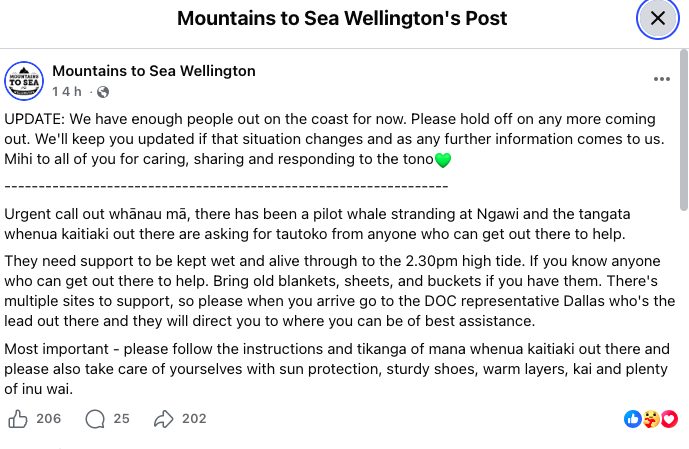
Mountains to Sea Wellington relays an "urgent call out" from the tangata whenua kaitiaki: the whales "need support to be kept wet and alive through to the 2.30pm high tide … There's multiple sites to support" [15]. In the comments: "you'll see DOC out there in Wellington atm but heading out now" [16]. Wellington is about two hours' drive from Ngāwī.
Mountains to Sea Wellington gibt einen „dringenden Aufruf" der Tangata-Whenua-Kaitiaki weiter: Die Wale „müssen bis zum Hochwasser um 14:30 Uhr nass und am Leben gehalten werden … Es gibt mehrere Orte" [15]. In den Kommentaren: „DOC ist gerade noch in Wellington, macht sich aber jetzt auf den Weg" [16]. Wellington liegt etwa zwei Autostunden von Ngāwī entfernt.
DOC mobilises an operations team, supported by Project Jonah, Ngāti Hinewaka, Ngāti Kahungunu ki Wairarapa and residents [1]. This is two hours after the first local call and many hours after the whales came ashore.
Das DOC mobilisiert ein Einsatzteam, unterstützt von Project Jonah, Ngāti Hinewaka, Ngāti Kahungunu ki Wairarapa und Anwohnern [1]. Das ist zwei Stunden nach dem ersten Anruf und viele Stunden nach der Strandung.
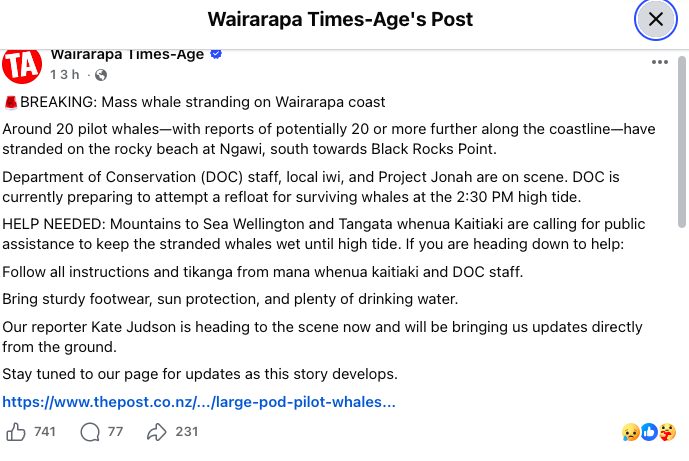
Wairarapa Times-Age: "HELP NEEDED … calling for public assistance to keep the stranded whales wet until high tide." Around 20 whales, with 20 or more reported further along [14].
Wairarapa Times-Age: „HILFE BENÖTIGT … Aufruf an die Öffentlichkeit, die Wale bis zum Hochwasser nass zu halten." Etwa 20 Wale, weitere 20 oder mehr weiter entlang der Küste [14].
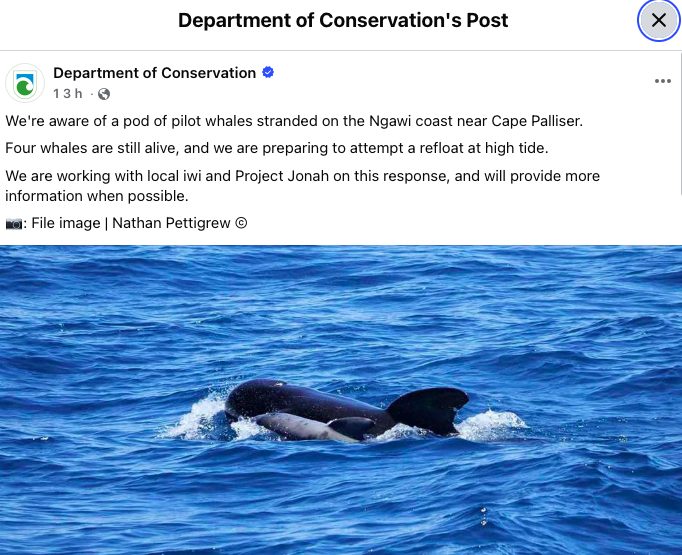
DOC on Facebook: "Four whales are still alive, and we are preparing to attempt a refloat at high tide." The post uses a file photo, not an image from the site [9].
DOC auf Facebook: „Vier Wale leben noch, und wir bereiten einen Rückführungsversuch bei Hochwasser vor." Der Beitrag verwendet ein Archivfoto, kein Bild vom Ort [9].
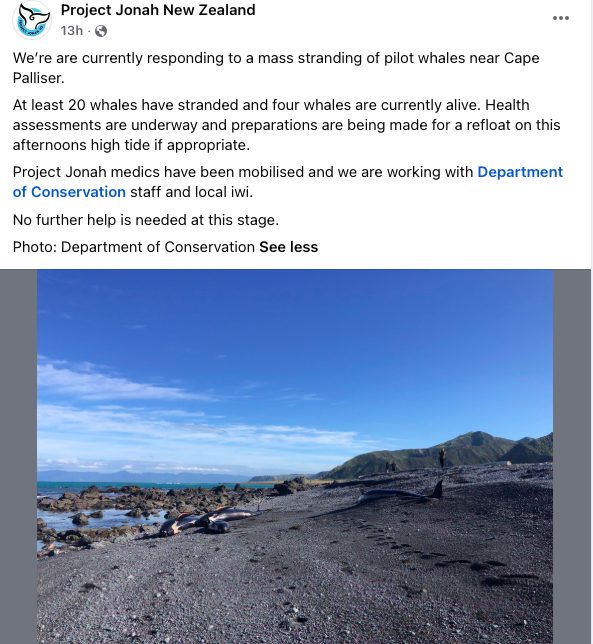
Project Jonah: "At least 20 whales have stranded and four whales are currently alive … preparations are being made for a refloat on this afternoon's high tide if appropriate … No further help is needed at this stage." [10]. Mountains to Sea Wellington later updates its call-out (time of the update not shown): "We have enough people out on the coast for now. Please hold off on any more coming out." [15]
Project Jonah: „Mindestens 20 Wale sind gestrandet, vier leben derzeit … Vorbereitungen für eine Rückführung beim heutigen Nachmittagshochwasser laufen, falls angemessen … Derzeit wird keine weitere Hilfe benötigt." [10]. Mountains to Sea Wellington aktualisiert später seinen Aufruf (Zeitpunkt nicht angezeigt): „Wir haben vorerst genug Leute an der Küste. Bitte kommt nicht mehr." [15]
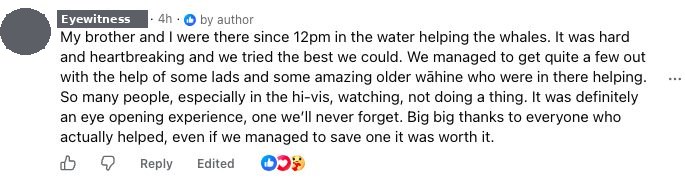
An eyewitness and her brother are in the water from about midday: "We managed to get quite a few out with the help of some lads and some amazing older wāhine" [13].
Eine Augenzeugin und ihr Bruder sind ab etwa Mittag im Wasser: „Mit Hilfe einiger Jungs und einiger großartiger älterer Wāhine haben wir ziemlich viele hinausbekommen" [13].
DOC tells 1News it is aware of two pods. "Four whales are still alive in the first pod … The second pod, further down the coast, is currently being assessed." 1News adds: "No further help was required at this stage." [3]
Das DOC teilt 1News mit, es wisse von zwei Gruppen. „Vier Wale leben noch in der ersten Gruppe … Die zweite Gruppe weiter die Küste hinunter wird derzeit begutachtet." 1News ergänzt: „Derzeit wird keine weitere Hilfe benötigt." [3]
Former South Wairarapa mayor Alex Beijen joins about 10 other people. He sees dozens of whales, many dead, spread over a kilometre, 20 near Mangatoetoe Beach alone. He and other volunteers help refloat around five whales: "they didn't come back in." He credits Ngāti Kahungunu ki Wairarapa, who "turned out in large numbers" [2].
Der frühere Bürgermeister von South Wairarapa, Alex Beijen, kommt zu etwa 10 anderen Helfern. Er sieht Dutzende Wale, viele tot, verteilt über einen Kilometer, allein 20 nahe Mangatoetoe Beach. Mit anderen Freiwilligen bringt er etwa fünf Wale zurück: „Sie kamen nicht zurück." Er lobt Ngāti Kahungunu ki Wairarapa, die „in großer Zahl" kamen [2].
A volunteer from another rescue group arrives with HUHA: "We were informed not to attend as there were plenty people here, however nothing was being done and most of the whale's had died by the time we arrived at 2pm." [17]
Eine Freiwillige einer anderen Rettungsgruppe trifft mit HUHA ein: „Uns wurde gesagt, wir sollten nicht kommen, weil genug Leute hier seien, aber es wurde nichts getan, und die meisten Wale waren tot, als wir um 14 Uhr ankamen." [17]
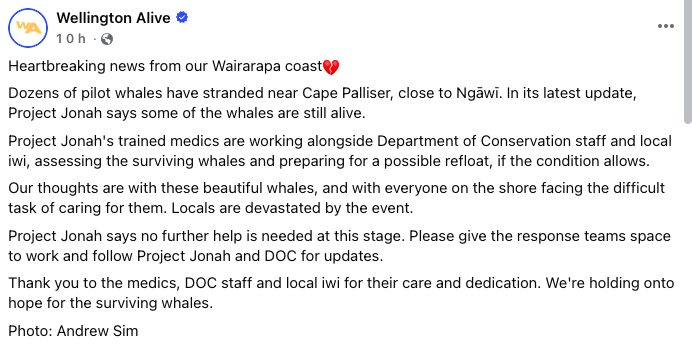
Wellington Alive repeats it: "Project Jonah says no further help is needed at this stage. Please give the response teams space to work" [20].
Wellington Alive wiederholt: „Laut Project Jonah wird derzeit keine weitere Hilfe benötigt. Bitte geben Sie den Einsatzteams Raum" [20].
High tide [2]. This was the one refloat window named by DOC and Project Jonah.
Hochwasser [2]. Dies war das einzige von DOC und Project Jonah genannte Rückführungsfenster.
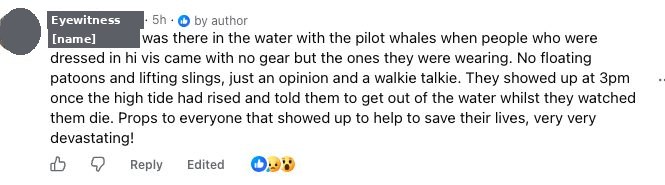
A commenter, relaying the account of a family member who was in the water: people "dressed in hi vis came with no gear … No floating pontoons and lifting slings, just an opinion and a walkie talkie. They showed up at 3pm once the high tide had risen and told them to get out of the water whilst they watched them die." [12]
Eine Kommentatorin gibt den Bericht eines Familienmitglieds wieder, das im Wasser war: Leute „in Warnwesten kamen ohne Ausrüstung … Keine Schwimmpontons und Hebeschlingen, nur eine Meinung und ein Funkgerät. Sie tauchten um 15 Uhr auf, als die Flut gestiegen war, und sagten ihnen, sie sollen aus dem Wasser gehen, während sie zusahen, wie sie starben." [12]
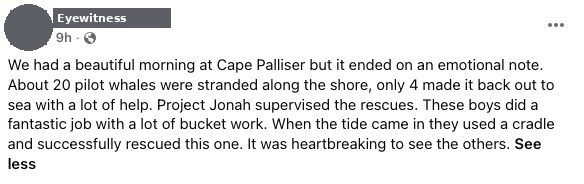
An eyewitness on the beach: "About 20 pilot whales were stranded along the shore, only 4 made it back out to sea with a lot of help. Project Jonah supervised the rescues … When the tide came in they used a cradle and successfully rescued this one." [19]
Eine Augenzeugin am Strand: „Etwa 20 Grindwale lagen am Ufer, nur 4 kamen mit viel Hilfe zurück ins Meer. Project Jonah beaufsichtigte die Rettung … Als die Flut kam, brachten sie diesen einen mit einer Trage erfolgreich zurück." [19]
DOC's acting operations manager tells the Times-Age "only one animal was understood to have been successfully refloated" [1]. A DOC statement to Stuff says about 20 whales "were present, and two animals have been successfully refloated" [2]. DOC medic Nikki Carmichael says some carcasses "have already been washed out to sea" and "it's pretty tricky to find them all" [7].
Die stellvertretende DOC-Einsatzleiterin sagt der Times-Age, „nur ein Tier wurde nach unserem Verständnis erfolgreich zurückgeführt" [1]. Eine DOC-Erklärung an Stuff spricht von etwa 20 Walen und „zwei erfolgreich zurückgeführten Tieren" [2]. DOC-Sanitäterin Nikki Carmichael sagt, einige Kadaver seien „bereits ins Meer gespült" worden, und „es ist ziemlich schwierig, sie alle zu finden" [7].
The volunteer from another rescue group posts: "Whale rescue got in with HUHA while all the other 'Marine medics' stood and watched." She describes a whale "on its side in a small space surrounded by rocks" whose "sad eye opened and looked at me as it passed away" [17]. In the comments, people who were at Ninety Mile Beach in October compare the two events [18].
Die Freiwillige der anderen Rettungsgruppe schreibt: „Whale Rescue ging mit HUHA ins Wasser, während alle anderen ‚Marine Medics' dastanden und zusahen." Sie beschreibt einen Wal „auf der Seite in einer kleinen, von Felsen umgebenen Stelle", dessen „trauriges Auge sich öffnete und mich ansah, als er starb" [17]. In den Kommentaren vergleichen Menschen, die im Oktober am Ninety Mile Beach waren, beide Ereignisse [18].
Reuters: at least 20 stranded, two refloated "so far"; locals tell RNZ up to 50 stranded and "most succumbed to their injuries". Ngāwī local Rob Bargh: "It's horrible. The ones that are alive are on their last breaths." [4] The Straits Times republishes at 8:07 pm NZDT [5].
Reuters: mindestens 20 gestrandet, „bislang" zwei zurückgeführt; Einheimische sagen RNZ, bis zu 50 seien gestrandet und „die meisten erlagen ihren Verletzungen". Ngāwī-Anwohner Rob Bargh: „Es ist furchtbar. Die noch leben, sind in ihren letzten Atemzügen." [4] Die Straits Times übernimmt um 20:07 Uhr NZDT [5].
The eyewitness who was in the water from midday: "So many people, especially in the hi-vis, watching, not doing a thing … even if we managed to save one it was worth it." [13]
Die Augenzeugin, die ab Mittag im Wasser war: „So viele Leute, vor allem in Warnwesten, die zuschauten und nichts taten … selbst wenn wir nur einen retten konnten, hat es sich gelohnt." [13]
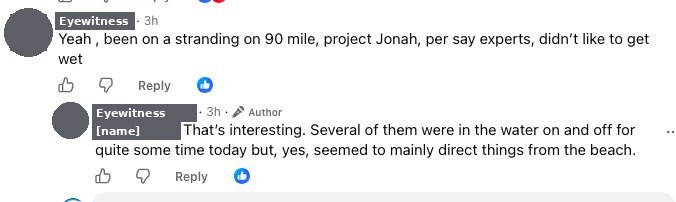
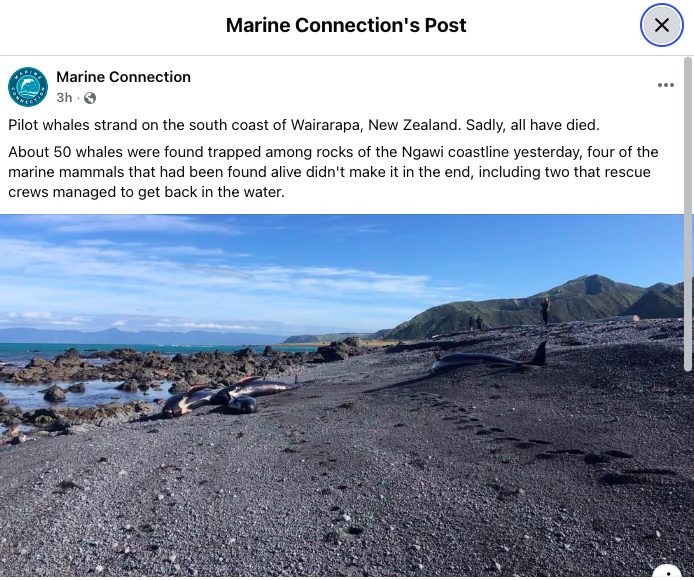
Marine Connection: "About 50 whales were found trapped among rocks … four of the marine mammals that had been found alive didn't make it in the end, including two that rescue crews managed to get back in the water." [23] The eyewitness on the beach, asked about Project Jonah: "Several of them were in the water on and off … but, yes, seemed to mainly direct things from the beach." [19]
Marine Connection: „Etwa 50 Wale wurden zwischen Felsen gefangen gefunden … vier der lebend gefundenen Tiere haben es am Ende nicht geschafft, darunter zwei, die die Retter ins Wasser zurückgebracht hatten." [23] Die Augenzeugin am Strand auf Nachfrage zu Project Jonah: „Einige waren immer wieder im Wasser … aber ja, sie schienen hauptsächlich vom Strand aus zu dirigieren." [19]
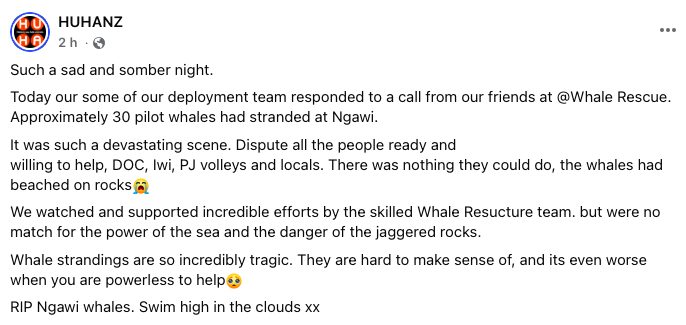
HUHANZ: "Approximately 30 pilot whales had stranded at Ngawi … There was nothing they could do, the whales had beached on rocks." [21]
HUHANZ: „Etwa 30 Grindwale waren in Ngāwī gestrandet … Man konnte nichts tun, die Wale waren auf Felsen gestrandet." [21]
1News changes its headline to "At least 30 whales dead in mass stranding at Cape Palliser". The body of the story still reads "Four whales are still alive in the first pod" [3]. There is still no DOC statement on the fate of the live whales, the second pod or any euthanasia.
1News ändert die Überschrift in „Mindestens 30 Wale tot nach Massenstrandung am Cape Palliser". Im Text steht weiterhin „Vier Wale leben noch in der ersten Gruppe" [3]. Weiterhin keine DOC-Erklärung zum Schicksal der lebenden Wale, der zweiten Gruppe oder zu Euthanasie.
Iwi, residents, Whale Rescue and HUHA went into the surf. Project Jonah volunteers were seen in the water "on and off" and one whale was carried out in a cradle [19]. But the official response that arrived from Wellington brought, by eyewitness accounts, no pontoons, no lifting slings and no boats. Its people largely stood on the beach and the rocks, directing [12][13][17][19]. The footage and photographs in our files show the same thing.
Iwi, Anwohner, Whale Rescue und HUHA gingen in die Brandung. Freiwillige von Project Jonah wurden „immer wieder" im Wasser gesehen, und ein Wal wurde in einer Trage hinausgebracht [19]. Doch der offizielle Einsatz aus Wellington brachte laut Augenzeugen keine Pontons, keine Hebeschlingen und keine Boote mit. Seine Leute standen überwiegend am Strand und auf den Felsen und dirigierten [12][13][17][19]. Die Aufnahmen in unseren Unterlagen zeigen dasselbe.
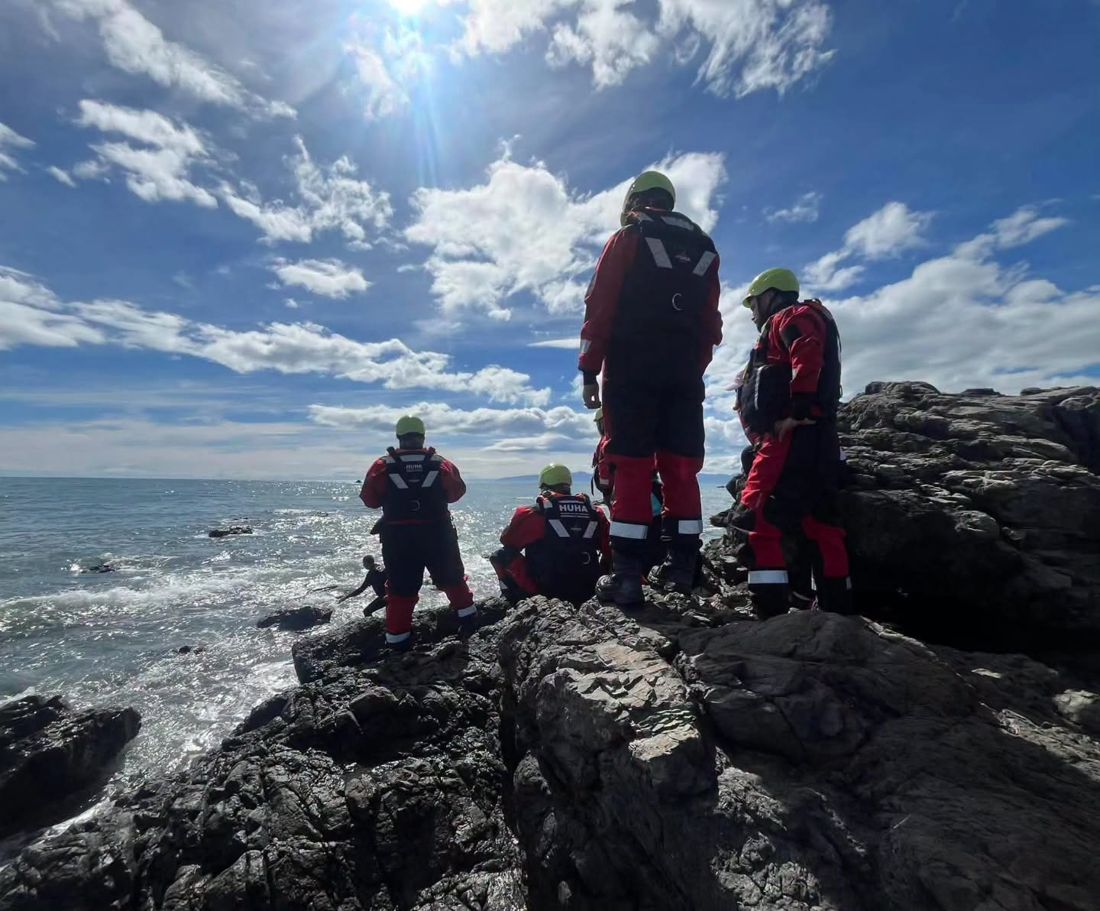
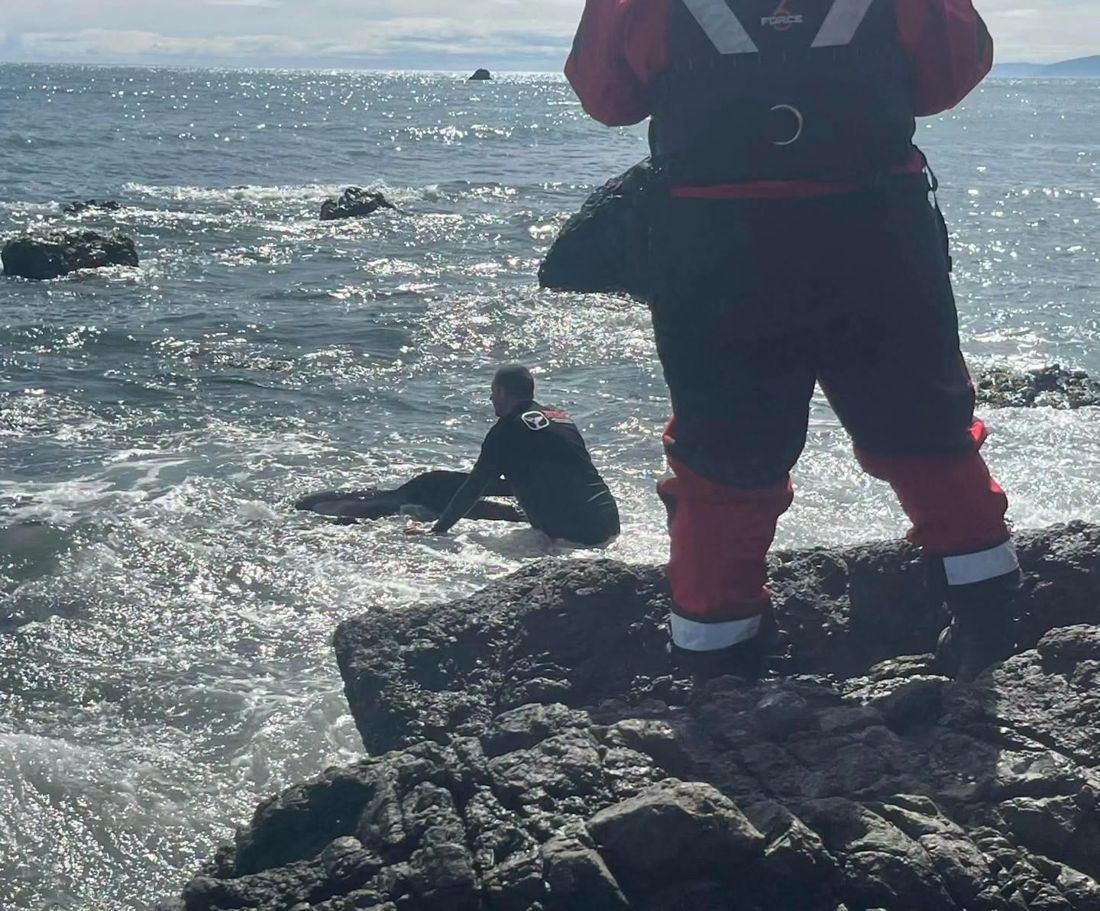
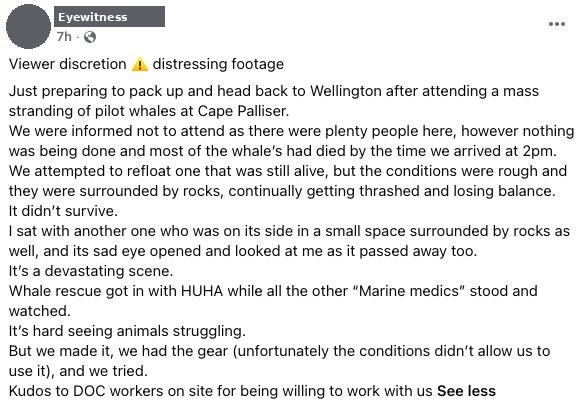
Nothing on this page minimises how difficult this coast is. The whales came ashore on volcanic rock and boulder beach, in surf, spread across at least three sites. A resident described them as high and dry, some cut up from being bashed around on the rocks [1]. The chair of Ngāti Hinewaka hapū said their "skin is broken in many places and they are quite damaged" [1]. Volunteers from another rescue group tried to refloat one whale, but it "continually [got] thrashed and [lost] balance" between the rocks [17]. The photographs show blood in the water. Rescuers in this surf are at real risk.
A hard site is a reason to bring more people, better equipment and a plan to move the animals somewhere else. It is not a reason to bring less. On rocks, refloating whales where they lie fails, as it did here. They must be lifted out and carried to open water, the way 114 pilot whales were moved in slings beside jet boats at Macquarie Harbour in 2020 [29]. That means boats, slings, mats and pontoons, arriving within hours of the first report.
Nichts auf dieser Seite verharmlost, wie schwierig diese Küste ist. Die Wale strandeten auf Vulkangestein und Geröllstrand, in der Brandung, verteilt auf mindestens drei Orte. Ein Anwohner beschrieb sie als hoch und trocken, einige aufgeschnitten, weil sie gegen die Felsen geschlagen wurden [1]. Der Vorsitzende des Hapū Ngāti Hinewaka sagte, ihre „Haut ist an vielen Stellen aufgerissen, sie sind schwer verletzt" [1]. Freiwillige einer anderen Rettungsgruppe versuchten, einen Wal zurückzuführen, doch er wurde zwischen den Felsen „ständig herumgeworfen und verlor das Gleichgewicht" [17]. Die Fotos zeigen Blut im Wasser. Helfer in dieser Brandung sind echten Gefahren ausgesetzt.
Ein schwieriger Ort ist ein Grund, mehr Menschen, bessere Ausrüstung und einen Plan zur Verlegung der Tiere mitzubringen. Er ist kein Grund, weniger mitzubringen. Auf Felsen scheitert die Rückführung an Ort und Stelle, wie hier geschehen. Die Wale müssen angehoben und ins offene Wasser getragen werden, so wie 2020 in Macquarie Harbour 114 Grindwale in Schlingen neben Jetbooten verlegt wurden [29]. Das bedeutet Boote, Schlingen, Matten und Pontons, die innerhalb weniger Stunden nach der ersten Meldung eintreffen.
Viewer discretion: injured and dying whales.Achtung: verletzte und sterbende Wale.
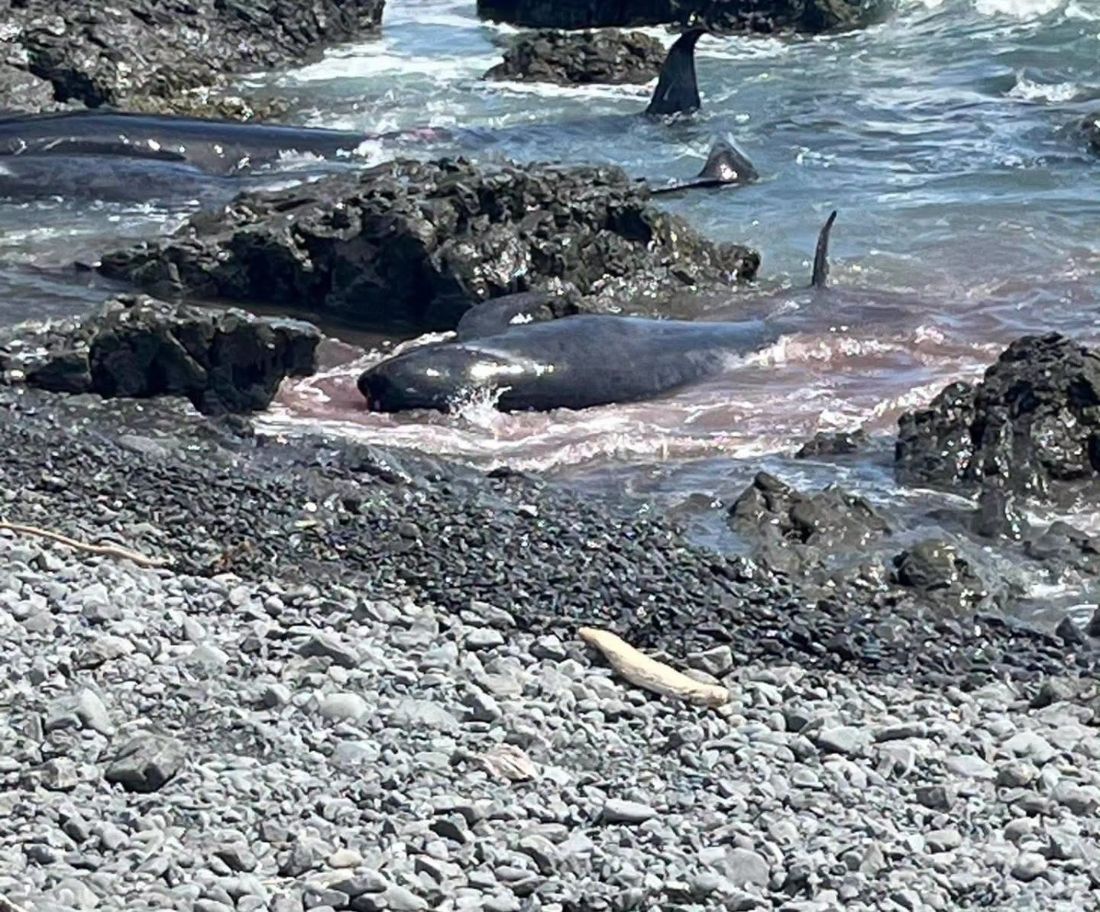
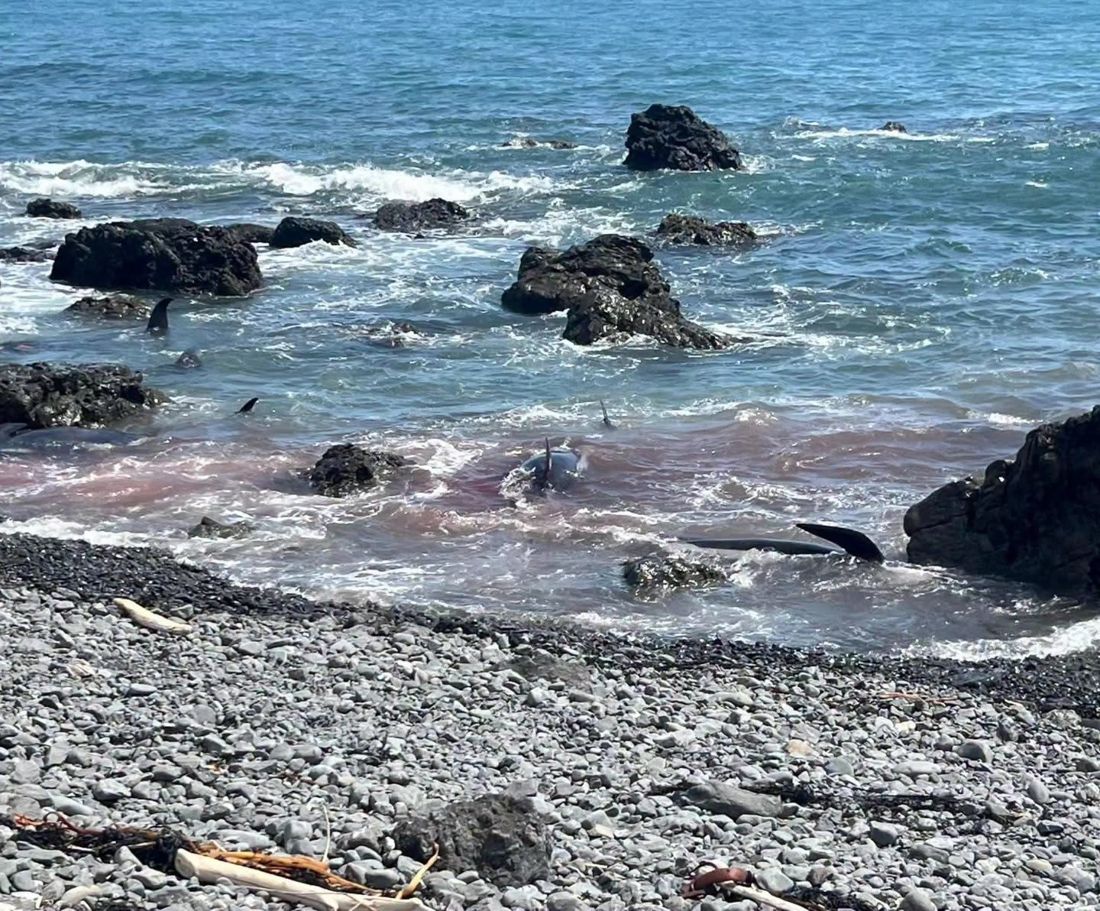
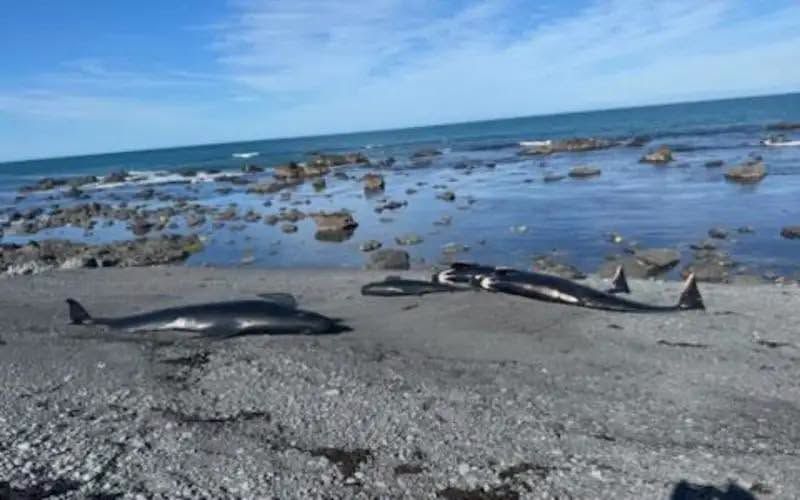
The same five words were posted at about noon on Thursday, while tangata whenua were still asking for hands and DOC was still on the road from Wellington. Project Jonah posted them, 1News printed them, and Wellington Alive repeated them. From that point the public was steered away from the beach. Trained rescuers say they were told not to come.
Stranded No More's position is that, in New Zealand stranding response, "no further help is needed" has come to work as a signal that the outcome has already been settled and that the public is about to be removed from it. One month ago at Ninety Mile Beach, the equivalent message was DOC's "please stay home tonight". Eleven whales were shot before the volunteers were allowed back [26]. On Thursday's posts, people who remember that responded in the same terms:
Dieselben Worte wurden am Donnerstag gegen Mittag veröffentlicht, während die Tangata Whenua noch um Helfer baten und das DOC noch von Wellington unterwegs war. Project Jonah veröffentlichte sie, 1News druckte sie, Wellington Alive wiederholte sie. Ab diesem Zeitpunkt wurde die Öffentlichkeit vom Strand ferngehalten. Ausgebildete Retter sagen, man habe ihnen gesagt, sie sollen nicht kommen.
Stranded No More vertritt die Position, dass „keine weitere Hilfe benötigt" bei Strandungen in Neuseeland zu einem Signal geworden ist, dass der Ausgang bereits feststeht und die Öffentlichkeit gleich davon ausgeschlossen wird. Vor einem Monat am Ninety Mile Beach lautete die entsprechende Botschaft des DOC „bitte bleiben Sie heute Nacht zu Hause". Elf Wale wurden erschossen, bevor die Freiwilligen zurückkehren durften [26]. Unter den Beiträgen vom Donnerstag reagierten Menschen, die sich daran erinnern, genau so:
We have no evidence that any whale was shot at Ngāwī. What we can document is that the phrase was issued at the moment help was most needed, and that it emptied the beach of the people who were saving whales. Afterwards the public was given no account of what happened to the survivors. If no whale was killed, DOC can say so today, with numbers.
Wir haben keine Beweise, dass in Ngāwī ein Wal erschossen wurde. Belegen können wir, dass der Satz genau dann veröffentlicht wurde, als Hilfe am dringendsten gebraucht wurde, und dass er den Strand von den Menschen leerte, die Wale retteten. Danach erhielt die Öffentlichkeit keine Auskunft darüber, was mit den Überlebenden geschah. Wenn kein Wal getötet wurde, kann das DOC das heute sagen, mit Zahlen.
Taken together, the record reads as a response that had already decided no whales would be saved, and was managing the scene rather than rescuing animals:
Zusammengenommen liest sich der Ablauf wie ein Einsatz, bei dem bereits feststand, dass keine Wale gerettet würden, und der den Ort verwaltete, statt Tiere zu retten:
That despair is understandable from a resident standing alone on a rock beach at 9 am. It is not acceptable as the operating assumption of the national authority. Worldwide, most mass-stranded pilot whales and dolphins are healthy animals that die because they stranded. On Cape Cod, 92% of mass-stranded animals necropsied between 2000 and 2006 had no significant disease [27], and where a concerted rescue was made, 78% were released without re-stranding [28].
Diese Verzweiflung ist bei einem Anwohner, der um 9 Uhr allein an einem Felsstrand steht, verständlich. Als Arbeitsannahme der nationalen Behörde ist sie nicht akzeptabel. Weltweit sind die meisten massengestrandeten Grindwale und Delfine gesunde Tiere, die sterben, weil sie gestrandet sind. Auf Cape Cod hatten 92 % der zwischen 2000 und 2006 obduzierten massengestrandeten Tiere keine wesentliche Erkrankung [27], und wo eine konzertierte Rettung erfolgte, wurden 78 % ohne erneute Strandung freigelassen [28].
A post circulating since Thursday says the Australian research vessel RV Investigator, "which features highly advanced multibeam sonar systems used for seafloor mapping, rounded Cape Palliser overnight and subsequently docked in Wellington" [22]. Some versions call it a "deep sea survey" or deep-sea mining vessel. It is a government research ship operated by Australia's CSIRO; we have seen no evidence of any mining connection. The sonar question remains open.
Ein seit Donnerstag kursierender Beitrag besagt, das australische Forschungsschiff RV Investigator, „das über hochmoderne Fächerecholote zur Meeresbodenkartierung verfügt, umrundete über Nacht Cape Palliser und legte anschließend in Wellington an" [22]. In manchen Fassungen wird es als „Tiefsee-Vermessungsschiff" oder Tiefseebergbau-Schiff bezeichnet. Es ist ein staatliches Forschungsschiff der australischen CSIRO; Hinweise auf eine Verbindung zum Bergbau haben wir nicht gefunden. Die Sonar-Frage bleibt offen.
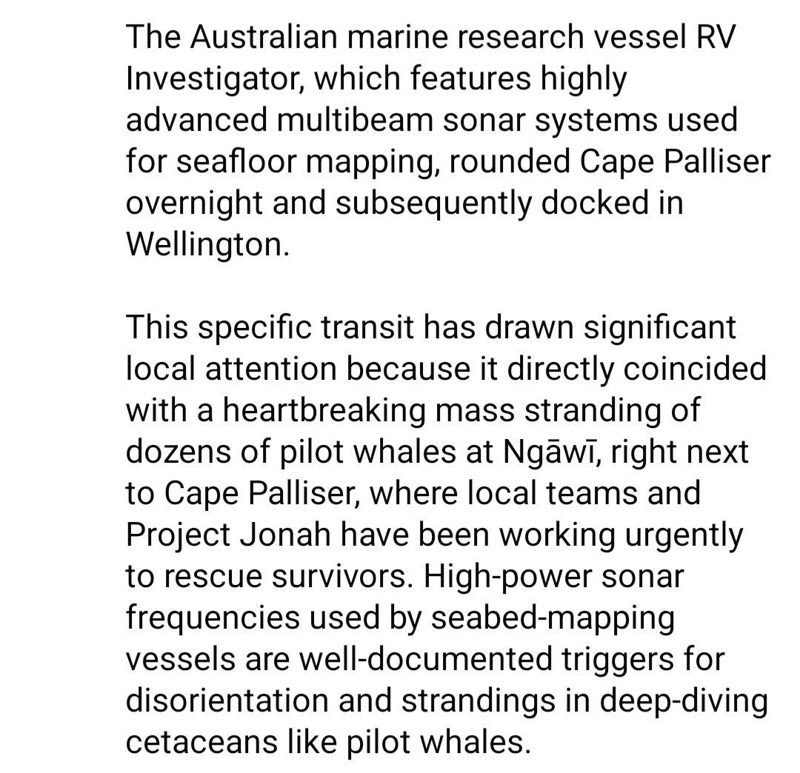
ConfirmedBestätigt
Not yet knownNoch unbekannt
In 2008, about 100 melon-headed whales, another deep-water dolphin species closely related to pilot whales, mass stranded in the Loza Lagoon, Madagascar. An Independent Scientific Review Panel (Southall, Rowles, Gulland, Baird and Jepson) found that a 12 kHz multibeam mapping echosounder operated by a survey vessel offshore was the "plausible and likely behavioral trigger" for the whales entering the lagoon [30][31]. It was the first time a mass stranding was linked to mapping sonar. The EM122 on RV Investigator is a 12 kHz deep-water multibeam of the same family. A link at Ngāwī is not established, but it is a question that must be answered with data, not dismissed. That requires the ship's track, its acoustic logs and full necropsies with ear and head examinations of the dead whales (Part 7 below).
2008 strandeten etwa 100 Breitschnabeldelfine, eine weitere eng mit Grindwalen verwandte Tiefwasserart, in der Loza-Lagune auf Madagaskar. Ein unabhängiges wissenschaftliches Gremium (Southall, Rowles, Gulland, Baird und Jepson) kam zu dem Schluss, dass ein 12-kHz-Fächerecholot eines Vermessungsschiffs vor der Küste der „plausible und wahrscheinliche Verhaltensauslöser" für das Einschwimmen in die Lagune war [30][31]. Es war das erste Mal, dass eine Massenstrandung mit Kartierungssonar in Verbindung gebracht wurde. Das EM122 der RV Investigator ist ein 12-kHz-Tiefwasser-Fächerecholot derselben Baureihe. Ein Zusammenhang in Ngāwī ist nicht belegt, aber die Frage muss mit Daten beantwortet und darf nicht abgetan werden. Dazu braucht es die Route des Schiffs, seine Akustikprotokolle und vollständige Nekropsien der toten Wale mit Untersuchung von Ohren und Kopf (Teil 7 unten).
The Global Whale Rescue Alliance (GWRA) protocol, founded by Stranded No More, is built for exactly this kind of coast. Its central point is that a pod heading for rocks must be met at sea, before it strands. If it does strand, the rescue moves the whales away from the trap and does not refloat them back into it [32].
Das Protokoll der Global Whale Rescue Alliance (GWRA), gegründet von Stranded No More, ist für genau solche Küsten gemacht. Sein Kernpunkt: Eine Gruppe, die auf Felsen zusteuert, muss auf See abgefangen werden, bevor sie strandet. Strandet sie doch, bringt die Rettung die Wale aus der Falle heraus, statt sie in dieselbe Falle zurückzusetzen [32].
| What happened at NgāwīWas in Ngāwī geschah | GWRA protocolGWRA-Protokoll |
|---|---|
| Pod reached rocks overnight unseen; first report from a pāua diver next morningGruppe erreichte nachts unbemerkt die Felsen; erste Meldung am Morgen durch einen Pāua-Taucher | Part 2, early detection: public sighting network (Whale Detective), shore observers, fixed acoustic stations and thermal cameras at known risk coasts flag a pod milling inshore hours before it strands. Survey and sonar vessel movements are logged against stranding-risk areas.Teil 2, Früherkennung: Sichtungsnetz der Öffentlichkeit (Whale Detective), Küstenbeobachter, feste Akustikstationen und Wärmebildkameras an Risikoküsten melden eine küstennah kreisende Gruppe Stunden vor der Strandung. Bewegungen von Vermessungs- und Sonarschiffen werden mit Strandungsrisikogebieten abgeglichen. |
| No boats on the waterKeine Boote auf dem Wasser | Part 8, Phase A (near-stranding): boats, including the public's boats under command, form a line on the shore side and herd the pod to deep water, while drones and thermal imaging find the sick or calving animal that may be leading it ashore [32].Teil 8, Phase A (Beinahe-Strandung): Boote, auch Boote der Öffentlichkeit unter Führung, bilden eine Linie zur Küste hin und treiben die Gruppe ins tiefe Wasser; Drohnen und Wärmebilder finden das kranke oder kalbende Tier, das die Gruppe womöglich an Land führt [32]. |
| DOC still in Wellington mid-morning; team mobilised ~11 amDOC am Vormittag noch in Wellington; Team gegen 11 Uhr mobilisiert | Principle VI, speed: certified local partners begin first aid within minutes, and the full team is called out on the first report [32].Prinzip VI, Schnelligkeit: zertifizierte lokale Partner leisten innerhalb von Minuten Erste Hilfe; das ganze Team wird bei der ersten Meldung alarmiert [32]. |
| "No further help is needed"; trained rescuers told not to attend„Keine weitere Hilfe benötigt"; ausgebildete Retter sollten nicht kommen | Principle X, the public: in a mass stranding the number of trained hands decides how many animals live. Volunteers are registered, briefed and given roles, never sent home [32].Prinzip X, Öffentlichkeit: Bei Massenstrandungen entscheidet die Zahl helfender Hände, wie viele Tiere überleben. Freiwillige werden registriert, eingewiesen und eingesetzt, nie nach Hause geschickt [32]. |
| Refloat attempted in the same rocks; whales thrashed and lost balanceRückführung in denselben Felsen; Wale wurden herumgeworfen und verloren das Gleichgewicht | Workflow M, step 8: relocate, do not refloat at the trap. Move whales in slings beside jet boats, on boat decks or by vehicle to a sheltered deep-water release site; rock each whale to restore balance first [29][32]. On Cape Cod, 90% of animals moved up to 40 km survived transport [28].Ablauf M, Schritt 8: verlegen statt an der Falle zurückführen. Wale in Schlingen neben Jetbooten, auf Bootsdecks oder per Fahrzeug zu einer geschützten Freilassungsstelle im tiefen Wasser bringen; vorher jeden Wal schaukeln, um das Gleichgewicht herzustellen [29][32]. Auf Cape Cod überlebten 90 % der bis zu 40 km transportierten Tiere den Transport [28]. |
| Everything pinned to one high tideAlles auf ein Hochwasser ausgerichtet | Workflow M, steps 2 and 6: first aid to every animal at once; hold and rest animals in water overnight when that is better than rushing, and use every following tide [32].Ablauf M, Schritte 2 und 6: Erste Hilfe für alle Tiere gleichzeitig; Tiere über Nacht im Wasser halten und ruhen lassen, wenn das besser ist, als zu hetzen, und jede folgende Flut nutzen [32]. |
| Refloated whales' fate unknownSchicksal der zurückgeführten Wale unbekannt | Principle IV: every released whale is tagged and tracked, with boats watching for re-stranding and the ability to step in again [32].Prinzip IV: Jeder freigelassene Wal wird markiert und verfolgt; Boote achten auf erneute Strandung und können erneut eingreifen [32]. |
| Carcasses washing out to sea; no necropsy announcedKadaver treiben ins Meer; keine Nekropsie angekündigt | Principle VII and Part 17: rapid, full necropsy of every dead whale, freshest first, including CT or dissection of ears and head to test for acoustic trauma and gas embolism. Results are compared with the public's photos and video, and published [32].Prinzip VII und Teil 17: schnelle, vollständige Nekropsie jedes toten Wals, die frischesten zuerst, einschließlich CT oder Präparation von Ohren und Kopf auf akustische Traumata und Gasembolie. Die Ergebnisse werden mit Fotos und Videos der Öffentlichkeit verglichen und veröffentlicht [32]. |
| Euthanasia neither confirmed nor deniedEuthanasie weder bestätigt noch dementiert | Principles I, II and V: no euthanasia; no animal is abandoned; every case is fully published [32].Prinzipien I, II und V: keine Euthanasie; kein Tier wird aufgegeben; jeder Fall wird vollständig veröffentlicht [32]. |
Rocky coasts like Cape Palliser will keep receiving pods. The only reliable way to save whales there is to reach them before they reach the rocks. This requires investment in monitoring and in teams who can be on the water within hours. That is the core of the GWRA protocol.
Felsküsten wie Cape Palliser werden weiterhin Walgruppen anziehen. Der einzige verlässliche Weg, dort Wale zu retten, ist, sie zu erreichen, bevor sie die Felsen erreichen. Dafür braucht es Investitionen in Überwachung und in Teams, die innerhalb weniger Stunden auf dem Wasser sein können. Das ist der Kern des GWRA-Protokolls.
This pod was neglected. The whales lay on the rocks through the night and most of the morning before an official team was on its way. When it arrived it brought no equipment to lift whales out of a rock trap, called off public help that was saving lives, and planned for a single tide. Then it went silent on the outcome.
We acknowledge the difficulty of the site and the danger to rescuers, and we honour the iwi, residents, Whale Rescue and HUHA volunteers who went into that surf. Their effort is not the failure here. The failure is a national response model that arrives late, under-equipped and already resigned, and then treats the public's questions as a nuisance.
Two mass strandings in five weeks have now ended with most or all of the whales dead and with the public excluded at the decisive moment. We call on the Department of Conservation to publish a full account of this event, with numbers, times, decisions and necropsy results, and to investigate the movements and sonar operations of RV Investigator off Cape Palliser. We call on New Zealand to invest in a proactive response: early detection, boats on the water, relocation away from trap sites, and teams that never say "no further help is needed" while a whale is still breathing.
Diese Walgruppe wurde vernachlässigt. Die Wale lagen die ganze Nacht und den größten Teil des Vormittags auf den Felsen, bevor ein offizielles Team unterwegs war. Als es eintraf, brachte es keine Ausrüstung mit, um Wale aus einer Felsfalle zu heben, sagte die öffentliche Hilfe ab, die Leben rettete, und plante für eine einzige Flut. Danach schwieg es zum Ausgang.
Wir erkennen die Schwierigkeit des Ortes und die Gefahr für die Retter an, und wir ehren die Iwi, Anwohner und Freiwilligen von Whale Rescue und HUHA, die in diese Brandung gingen. Nicht ihr Einsatz ist hier gescheitert. Gescheitert ist ein nationales Einsatzmodell, das spät, schlecht ausgerüstet und bereits resigniert ankommt und die Fragen der Öffentlichkeit dann als Störung behandelt.
Zwei Massenstrandungen in fünf Wochen endeten nun mit dem Tod der meisten oder aller Wale und mit dem Ausschluss der Öffentlichkeit im entscheidenden Moment. Wir fordern das Department of Conservation auf, einen vollständigen Bericht über dieses Ereignis zu veröffentlichen, mit Zahlen, Zeiten, Entscheidungen und Nekropsieergebnissen, und die Bewegungen und Sonaroperationen der RV Investigator vor Cape Palliser zu untersuchen. Wir fordern Neuseeland auf, in einen vorausschauenden Einsatz zu investieren: Früherkennung, Boote auf dem Wasser, Verlegung weg von Strandungsfallen und Teams, die niemals „keine weitere Hilfe benötigt" sagen, solange ein Wal noch atmet.
Prepared 5 November 2026 for sending by email to the recipients below. SNM cannot submit web forms due to IP exposure concerns.Vorbereitet am 5. November 2026 zum Versand per E-Mail an die unten genannten Empfänger. SNM kann aus Gründen der IP-Exposition keine Webformulare nutzen.
| RecipientEmpfänger | RoleFunktion | StatusStatus | |
|---|---|---|---|
| Department of Conservation (DOC) | Government agency responsible for marine mammal protection in New ZealandStaatliche Behörde für den Schutz von Meeressäugern in Neuseeland | info@doc.govt.nz (publicly available)(öffentlich verfügbar) | To be sentZu versenden |
| Project Jonah | Marine mammal rescue organisationOrganisation zur Rettung von Meeressäugern | info@projectjonah.org.nz (publicly available)(öffentlich verfügbar) | To be sentZu versenden |
SUBJECT: Formal Request for Information and Investigation — Mass Stranding of Pilot Whales, Ngāwī / Cape Palliser, 4–5 November 2026
Dear Sir / Madam,
We write on behalf of Stranded No More (SNM), an international watchdog group of stranding professionals, regarding the mass stranding of pilot whales on the Ngāwī coast near Cape Palliser on 4–5 November 2026.
Seventeen hours after the first report, there is still no public account of how many whales stranded, how many were alive, how many were refloated, how many survived, or whether any were euthanised. Official figures given on the same day contradict one another (four alive; two refloated; one refloated), and counts in the media range from 14 to 50 whales. A second pod that DOC said was "being assessed" has not been mentioned since. We are also concerned by eyewitness accounts that trained rescuers were told not to attend, that people in the water were ordered out at about 3 pm, and that no boats, slings or pontoons were deployed.
We respectfully request answers to the following questions.
Regarding numbers and locations
1. How many pilot whales stranded in total, at which sites (with coordinates), and in how many groups? Which species?
2. How many were alive at first DOC assessment, at the 2:30 pm high tide, and at nightfall on 5 November?
3. What happened to the second pod that DOC told 1News was "being assessed" at 12:42 pm? How many animals did it contain, and how many were alive?
4. Your own statements say one whale and two whales were refloated, while eyewitnesses report four and five. How many were refloated, and were any re-sighted, re-stranded or tagged?
Regarding the response
5. At what time was DOC first notified, and at what time did DOC and Project Jonah personnel arrive at each site?
6. Who decided that "no further help is needed at this stage", at what time, and on what assessment, given that whales were alive and tangata whenua were asking for help?
7. Who instructed trained rescuers from other rescue groups not to attend, and who instructed people in the water to leave at about 3 pm? For what reason?
8. What equipment (boats, slings, pontoons, mats, stretchers) was deployed? If none, why not?
9. Was relocation of whales away from the rock trap to a deep-water release site considered? If not, why not?
10. Was any plan made to hold and care for surviving whales overnight and attempt refloats on later tides?
Regarding euthanasia
11. Was any whale euthanised or shot? If so: how many; when; by whom; by what method; who authorised it; and under what legal authority under the Marine Mammals Protection Act 1978?
12. Was each animal individually assessed by a qualified veterinarian before any such decision? Please provide the assessment records.
13. What was the fate of each of the four whales DOC reported alive at midday?
Regarding the survey vessel RV Investigator
We ask DOC to investigate, and to publish its findings on, the whereabouts and acoustic activity of the CSIRO research vessel RV Investigator in the days before the stranding. Its voyage IN2026_V06 was scheduled to begin a Wellington port call on 5 November, and public reports state that it rounded Cape Palliser on the night the whales stranded. We specifically ask:
14. What was the vessel's track (AIS record) between 1 and 6 November 2026, and what were its closest approach to the Ngāwī coast and the time of that approach?
15. Which of its acoustic systems (Kongsberg EM122, EM710, EM2040c, ME70, sub-bottom profiler, ADCPs) were transmitting within New Zealand waters, and specifically in or near Palliser Bay, Cook Strait and off the Wairarapa coast? Please obtain the acoustic logs from CSIRO's Marine National Facility.
16. Did DOC or any New Zealand authority receive notice of these operations, and were any marine mammal observation or mitigation measures required or applied?
17. Were any other survey, seismic or naval sonar activities taking place in the region between 1 and 5 November?
18. Will DOC compare the vessel's track and acoustic timeline against the stranding and the necropsy findings, and publish the result?
Regarding necropsies and transparency
19. Will full necropsies be carried out on the freshest carcasses, including CT or dissection of ears and heads for acoustic trauma and examination for gas and fat embolism? Will tissue samples be preserved for independent analysis?
20. How many carcasses were lost to the sea, and is any effort being made to recover them?
21. Will DOC publish a full incident report, including timelines, counts, decisions and necropsy results?
We request a response within 14 working days.
Respectfully,
Stranded No More
strandednomore@proton.me
BETREFF: Formelle Informations- und Untersuchungsanfrage — Massenstrandung von Grindwalen, Ngāwī / Cape Palliser, 4.–5. November 2026
Sehr geehrte Damen und Herren,
wir schreiben im Namen von Stranded No More (SNM), einer internationalen Beobachtergruppe von Strandungsexperten, bezüglich der Massenstrandung von Grindwalen an der Küste bei Ngāwī nahe Cape Palliser am 4.–5. November 2026.
Siebzehn Stunden nach der ersten Meldung gibt es noch immer keine öffentliche Auskunft darüber, wie viele Wale strandeten, wie viele lebten, wie viele zurückgeführt wurden, wie viele überlebten und ob Wale eingeschläfert wurden. Die offiziellen Angaben vom selben Tag widersprechen sich (vier lebend; zwei zurückgeführt; einer zurückgeführt), und die Zahlen in den Medien reichen von 14 bis 50 Walen. Eine zweite Gruppe, die laut DOC „begutachtet wurde", wird seitdem nicht mehr erwähnt. Zudem besorgen uns Augenzeugenberichte, wonach ausgebildeten Rettern gesagt wurde, sie sollten nicht kommen, Menschen im Wasser gegen 15 Uhr herausbeordert wurden und keine Boote, Schlingen oder Pontons eingesetzt wurden.
Wir bitten respektvoll um Antworten auf folgende Fragen.
Zu Zahlen und Orten
1. Wie viele Grindwale strandeten insgesamt, an welchen Orten (mit Koordinaten) und in wie vielen Gruppen? Welche Art?
2. Wie viele lebten bei der ersten DOC-Begutachtung, beim Hochwasser um 14:30 Uhr und bei Einbruch der Nacht am 5. November?
3. Was geschah mit der zweiten Gruppe, die laut DOC gegenüber 1News um 12:42 Uhr „begutachtet wurde"? Wie viele Tiere umfasste sie, und wie viele lebten?
4. Ihre eigenen Angaben nennen einen bzw. zwei zurückgeführte Wale, Augenzeugen vier und fünf. Wie viele wurden zurückgeführt, und wurden sie wiedergesichtet, erneut gestrandet oder markiert?
Zum Einsatz
5. Wann wurde das DOC erstmals informiert, und wann trafen DOC- und Project-Jonah-Mitarbeiter an den einzelnen Orten ein?
6. Wer entschied, dass „derzeit keine weitere Hilfe benötigt" werde, wann und auf welcher Grundlage, obwohl Wale lebten und die Tangata Whenua um Hilfe baten?
7. Wer wies ausgebildete Retter anderer Rettungsgruppen an, nicht zu kommen, und wer forderte die Menschen im Wasser gegen 15 Uhr auf, es zu verlassen? Aus welchem Grund?
8. Welche Ausrüstung (Boote, Schlingen, Pontons, Matten, Tragen) wurde eingesetzt? Falls keine, warum nicht?
9. Wurde eine Verlegung der Wale aus der Felsfalle zu einer Freilassungsstelle im tiefen Wasser erwogen? Falls nicht, warum nicht?
10. Gab es einen Plan, überlebende Wale über Nacht zu betreuen und bei späteren Fluten erneut zurückzuführen?
Zur Euthanasie
11. Wurde ein Wal eingeschläfert oder erschossen? Wenn ja: wie viele, wann, von wem, mit welcher Methode, wer hat es genehmigt und auf welcher Rechtsgrundlage nach dem Marine Mammals Protection Act 1978?
12. Wurde jedes Tier vor einer solchen Entscheidung einzeln von einem qualifizierten Tierarzt untersucht? Bitte stellen Sie die Untersuchungsunterlagen zur Verfügung.
13. Was geschah mit jedem der vier Wale, die das DOC mittags als lebend meldete?
Zum Vermessungsschiff RV Investigator
Wir bitten das DOC, den Aufenthaltsort und die akustischen Aktivitäten des CSIRO-Forschungsschiffs RV Investigator in den Tagen vor der Strandung zu untersuchen und die Ergebnisse zu veröffentlichen. Seine Fahrt IN2026_V06 sollte am 5. November einen Hafenaufenthalt in Wellington beginnen, und öffentlichen Berichten zufolge umrundete es Cape Palliser in der Nacht der Strandung. Wir fragen konkret:
14. Wie verlief die Route des Schiffs (AIS-Daten) zwischen dem 1. und 6. November 2026, und wann und wie nah kam es der Küste bei Ngāwī?
15. Welche seiner akustischen Systeme (Kongsberg EM122, EM710, EM2040c, ME70, Sedimentecholot, ADCPs) sendeten in neuseeländischen Gewässern, insbesondere in oder nahe der Palliser Bay, der Cookstraße und vor der Wairarapa-Küste? Bitte fordern Sie die Akustikprotokolle bei der Marine National Facility der CSIRO an.
16. Wurde das DOC oder eine andere neuseeländische Behörde über diese Operationen informiert, und waren Maßnahmen zur Beobachtung oder zum Schutz von Meeressäugern vorgeschrieben oder wurden sie angewandt?
17. Fanden zwischen dem 1. und 5. November weitere Vermessungs-, seismische oder militärische Sonaraktivitäten in der Region statt?
18. Wird das DOC Route und akustische Zeitachse des Schiffs mit der Strandung und den Nekropsiebefunden abgleichen und das Ergebnis veröffentlichen?
Zu Nekropsien und Transparenz
19. Werden an den frischesten Kadavern vollständige Nekropsien durchgeführt, einschließlich CT oder Präparation von Ohren und Kopf auf akustische Traumata sowie Untersuchung auf Gas- und Fettembolie? Werden Gewebeproben für unabhängige Analysen aufbewahrt?
20. Wie viele Kadaver wurden ins Meer gespült, und gibt es Bemühungen, sie zu bergen?
21. Wird das DOC einen vollständigen Einsatzbericht mit Zeitachse, Zahlen, Entscheidungen und Nekropsieergebnissen veröffentlichen?
Wir bitten um eine Antwort innerhalb von 14 Arbeitstagen.
Mit freundlichen Grüßen
Stranded No More
strandednomore@proton.me
| DateDatum | FromVon | SummaryZusammenfassung |
|---|---|---|
| — | — | No replies yet.Noch keine Antworten. |
Screenshots captured on Thursday 5 November 2026 between 7:09 and 7:51 am ET (1:09–1:51 am NZDT, Friday 6 November). Each is kept so that the times and wording above can be checked.
Screenshots, aufgenommen am Donnerstag, 5. November 2026, zwischen 7:09 und 7:51 Uhr ET (1:09–1:51 Uhr NZDT, Freitag, 6. November). Sie werden aufbewahrt, damit Zeiten und Wortlaut oben überprüft werden können.




The stranding sites lie along the coast road south of the fishing settlement of Ngāwī towards Black Rocks Point and Mangatoetoe Beach, on the eastern side of Palliser Bay, a few kilometres from Cape Palliser lighthouse. The nearest DOC base used in the response was in Wellington, about two hours away by road. Cook Strait and the approaches to Wellington Harbour lie to the west. Open the area in OpenStreetMap.
Die Strandungsorte liegen entlang der Küstenstraße südlich der Fischersiedlung Ngāwī in Richtung Black Rocks Point und Mangatoetoe Beach, an der Ostseite der Palliser Bay, wenige Kilometer vom Leuchtturm Cape Palliser entfernt. Der nächste beim Einsatz genutzte DOC-Standort war Wellington, etwa zwei Autostunden entfernt. Westlich liegen die Cookstraße und die Zufahrt zum Hafen von Wellington. Gebiet in OpenStreetMap öffnen.