Banahm -- The Whale No One Helped
Summary of Events
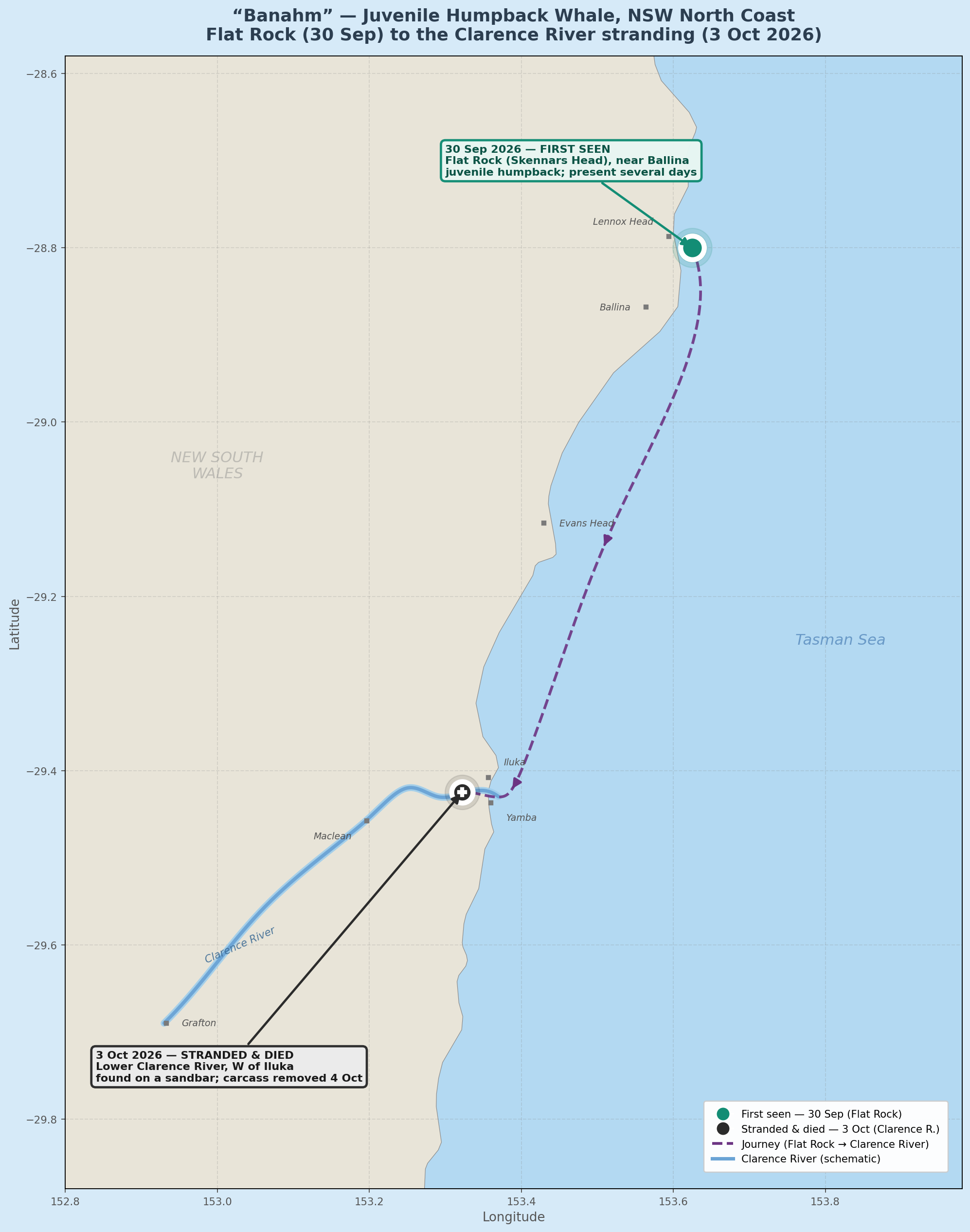
"Banahm" -- a name given by Stranded No More, meaning "little brother" in the Bundjalung language of the region where he died -- was a juvenile humpback whale first spotted off Flat Rock, near Lennox Head, New South Wales, around 30 September 2026. He had reportedly been in the area for several days. He was visibly unwell: emaciated, infested with whale lice, and in poor body condition. His clinical presentation was strikingly similar to that of Hartwin, a juvenile humpback whale who died in European waters in August 2026 after seven months of observation and zero intervention.
Banahm was reported to ORRCA (Organisation for the Rescue and Research of Cetaceans in Australia) and the NSW National Parks and Wildlife Service. No diagnostic sampling was performed. No treatment was attempted.
By 3 October 2026, Banahm had traveled approximately 11 kilometres up the Clarence River -- abnormal behaviour for a humpback whale. He stranded on a sandbar near Iluka, on the Mid North Coast. ORRCA was notified at 1:30 pm on Saturday. When volunteers arrived, Banahm was already dead.
On Sunday 4 October, Crown Lands removed the carcass from the river and towed it out to sea. No necropsy was performed. No samples were taken. No cause of death was established. The only official response was a shark warning advising people to stay out of the water for a week.
Banahm died the same way Hartwin died -- watched, reported, and left to his fate. He entered the Clarence River already sick and weakened. He was found dead within days of being reported. And when it was over, his body was disposed of at sea, erasing any possibility of understanding what killed him, or whether it could have been prevented.
Diagnostic Samples Taken
Treatment Attempted
Necropsy Performed
Timeline of Events
Hartwin's Little Brother
Two juvenile humpback whales. Two opposite sides of the world. The same clinical presentation. The same outcome. The same institutional silence.
Hartwin was a juvenile humpback whale observed across eight European countries from January to August 2026. He was visibly emaciated, covered in whale lice, and in declining health. He was photographed, filmed, and reported on by media outlets across Europe. He was observed by marine mammal researchers, conservation authorities, and stranding networks in multiple countries. Not a single diagnostic sample was ever taken from him while he was alive. Not a single treatment was ever attempted.
Hartwin died in August 2026. The necropsy, performed by the German Oceanographic Museum (Deutsches Meeresmuseum), found four abscesses and suspected sepsis with shock. No external injuries from ship strikes or entanglement were found. Hartwin died of a progressive, treatable bacterial infection -- one that modern veterinary medicine can diagnose with a breath sample and treat with long-acting antibiotics delivered by remote dart.
The infection went undiagnosed because nobody collected a sample. It went untreated because nobody tried.
Now look at Banahm. The same emaciation. The same whale lice infestation. The same deteriorating body condition. The same lethargy and abnormal behaviour. Two whales that looked so alike, it was, in the words of one observer, "quite eerie."
We do not know whether Banahm had the same disease. That is the point. We do not know because nobody checked. And now we can never know, because his body was towed out to sea and dumped, without a single sample being taken.
Side-by-Side: Hartwin and Banahm
| Hartwin (Europe) | Banahm (Australia) | |
|---|---|---|
| Species | Humpback whale, juvenile | Humpback whale, juvenile |
| Condition | Emaciated, whale lice, skin lesions | Emaciated, whale lice, poor body condition |
| Duration observed | ~7 months (Jan -- Aug 2026) | ~4 -- 5 days (late Sep -- 3 Oct 2026) |
| Reported to authorities | Yes, in multiple countries | Yes (ORRCA, NSW NPWS) |
| Diagnostic samples taken | None while alive | None |
| Treatment attempted | None | None |
| Necropsy | Yes (post-mortem) | No -- carcass disposed of at sea |
| Cause of death | Bacterial infection (abscesses, suspected sepsis) | Unknown -- permanently unknown |
| Lessons learned | Condition was treatable; intervention was possible | None -- no data was collected |
| Response to SNM letter | Varied (some responses received) | No reply from any organisation |
What We Do Not Know -- And Why That Matters
The dominant narrative around sick or stranded whales is a familiar one: this is nature, there is nothing we can do, the animal is wild, let it take its course. This narrative is comfortable. It is also self-serving, because it removes any obligation to act, to investigate, or to learn.
But consider what we do not know about Banahm:
- We do not know how he came to be in the condition he was found in.
- We do not know whether his illness was caused by a natural pathogen, or whether it was triggered or worsened by human activity.
- We do not know whether he was entangled at some point in his life and freed himself, sustaining injuries that later became infected.
- We do not know whether he ingested marine debris that damaged his digestive system.
- We do not know whether chemical pollutants, microplastics, or other contaminants in the ocean weakened his immune system.
- We do not know whether noise pollution from shipping, seismic surveys, or naval sonar disrupted his feeding patterns, drove him off his migratory route, or caused him to enter unsuitable waters.
- We do not know whether the food sources he depended on were depleted by overfishing or disrupted by changing ocean temperatures.
- We do not know whether he simply could not find enough food due to inexperience as a juvenile whale.
We do not know any of this. And now we never will.
The same was true for Hartwin. For seven months, authorities across Europe said there was nothing to be done. "Let nature take its course," they said. "He is a wild animal." "Human intervention is not always a good thing." And when the necropsy finally came, it showed a treatable bacterial infection -- not a ship strike, not entanglement, not something inherently beyond the reach of veterinary medicine.
This gap in knowledge is not neutral. It is exploited. When the cause of a whale's illness is unknown, it is easy to say "this is just nature." But the oceans are no longer pristine. Both Hartwin and Banahm were juvenile whales. Both could have been entangled at some point. Both could have been unable to find enough food due to inexperience or disrupted food webs. Both could have been weakened by pollutants or stressed by underwater noise. Their routes could have been disturbed by human activities.
We cannot rule out that it was human activities, in one way or another, that led to their demise. Everyone who opens their mouth to say "let nature take its course" or "we do not owe these whales help, rescue, or medical attention" should think about that.
And when a whale's body is towed offshore without a necropsy, it is not just a dead animal being disposed of. It is evidence being destroyed. It is knowledge being deliberately not acquired. Authorities benefit from this ignorance, because what you do not know, you do not have to act on. What you do not test for, you do not have to treat. What you do not document, you do not have to explain.
The Convenient Ignorance
Banahm's carcass was towed out to sea without a necropsy. No tissue samples were collected. No cause of death was established. It is as though he never existed.
If Banahm had the same bacterial infection that killed Hartwin, we will never know. If he was carrying a disease that could affect other whales in the population, we will never know. If his death was linked to human activity -- pollution, noise, entanglement, depleted prey -- we will never know.
The absence of a necropsy is not a neutral act. It is a choice to remain ignorant. And ignorance, for those who have the power to act, is a form of permission to do nothing.
The Cases Nobody Reports
Hartwin became an international story. He was photographed by whale watchers, tracked by researchers, and covered by media across Europe. Even so, no authority in any of the eight countries where he was observed took action to diagnose or treat him.
Banahm did not even get that. A local photographer posted about him on social media. A few people tagged the authorities. And when he died, the only news story was about the shark risk his decomposing body posed to swimmers.
The ABC headline read: "Shark danger in Clarence River after whale carcass removed, marine biologist says." The story was about sharks. Not about the whale. Not about why he was sick. Not about why no one helped him. Not about whether his death could have been prevented. The whale was a hazard to be managed. The only expert quoted was a marine biologist warning people to stay out of the water.
This is not unusual. It is the norm. Around the world, whales strand, sicken, and die, and the vast majority of these cases never make the news. When they do, the framing is almost always the same: a sad but natural event, beyond human control, best left to nature. The organisations responsible for marine mammal welfare -- the stranding networks, the conservation agencies, the rescue charities -- rarely advocate publicly for intervention. Many of them actively discourage it.
The result is a system in which:
- Sick whales are observed but not examined
- Reports are filed but not acted upon
- Deaths are recorded but not investigated
- Bodies are disposed of without data being collected
- Letters of inquiry go unanswered
And at the end of it, the official record shows a whale that stranded and died of unknown causes, with no evidence of human responsibility, and no indication that anything could have been done. The system is self-reinforcing: by not investigating, authorities ensure there is nothing to find. By not trying, they ensure there is no treatment to evaluate. By not performing necropsies, they ensure there is no cause of death to explain.
Banahm is not an isolated case. He is the default outcome. He is what happens to whales everywhere, every day, when the answer is always "let nature take its course."
The Value of a Whale
What Is a Whale Worth?
The International Monetary Fund (IMF) estimated in 2019 that a single great whale is worth approximately US$2 million over its lifetime in ecosystem services alone -- including carbon sequestration, nutrient cycling, and support of marine food webs. The IMF valued the global stock of great whales at more than US$1 trillion.
Whales fertilise phytoplankton through their faecal plumes, driving primary production in the ocean. Phytoplankton produce more than 50% of the world's oxygen and capture an estimated 37 billion tonnes of CO2 per year -- equivalent to four Amazon rainforests. Every whale that dies prematurely is a loss not only to its species but to the ocean ecosystem and the global climate.
A single drone blow-sampling flight costs a few hundred dollars. A long-acting antibiotic dart costs less than that. The cost of not acting is measured in millions.
But the value of a whale is not only economic. Every whale is a sentient being -- an individual with a life, a history, and a capacity for suffering. Banahm was a juvenile. He may have been separated from his mother. He was sick, alone, and struggling. A marine biologist who reviewed the footage speculated that "perhaps a mother and calf did come into the mouth [of the river] and perhaps the mother turned away and the baby kept going."
That sentence should stop anyone in their tracks. A confused, sick, juvenile whale, possibly separated from his mother, swimming 11 kilometres up a river he should never have entered, until he ran aground on a sandbar and died alone. And the response from the authorities tasked with his welfare was to tow his body out to sea and warn people about sharks.
A local filmmaker who recorded footage of Banahm's body in the river said filming it was "unsettling." She said: "It felt wrong, honestly. But I reminded myself why I do this -- to show compassion, to understand, and to share whatever knowledge I can gather."
A member of the public showed more scientific instinct than the agencies responsible for marine mammal welfare.
Unanswered Questions
The following questions remain unanswered. SNM wrote to ORRCA, the NSW National Parks and Wildlife Service, and the NSW Department of Climate Change, Energy, the Environment and Water on 4 October 2026. No reply has been received from any organisation.
- When did ORRCA and NSW NPWS first become aware of Banahm's presence off Flat Rock, and what assessment was made of his condition?
- Was any diagnostic sampling considered -- including drone-based blow collection, which requires no contact with the animal? If not, why not?
- Was any veterinary assessment of Banahm's condition conducted, either remotely (from photographs and footage) or in person? If so, what was the conclusion?
- Was antibiotic treatment by remote darting considered, given the visible similarity to Hartwin's condition and the known outcome of Hartwin's case? If not, why not?
- Why was Banahm's behaviour -- entering a river system and travelling 11 km upstream -- not treated as an emergency requiring immediate veterinary response?
- Why was no necropsy performed on Banahm's body before it was towed out to sea?
- Who made the decision to dispose of the carcass at sea, and on what basis?
- Were any tissue, blubber, or skin samples collected from the carcass before disposal?
- Is ORRCA or NSW NPWS aware of the Hartwin case and the necropsy findings showing a treatable bacterial infection? If so, did this inform any aspect of their response to Banahm?
- What protocols exist for responding to a visibly sick whale that has been reported to authorities and remains in a known location for several days?
- Why has no reply been received to SNM's letter of 4 October 2026, despite written requests to three separate organisations?
Statement from Stranded No More
Banahm has now joined Hartwin -- his "big brother." Both whales have died, a world apart, yet they shared the same fate, the same indifference and callousness of authorities, so-called "experts," so-called "rescues," so-called "conservationists," and so-called "cetacean-saving charities" who never even bothered to report on either of them.
We do not know how Banahm came to be in this condition, and this gap in knowledge is exploited by those who say "let nature take its course," or "whales get sick and die, deal with it, humans do not need to intervene." But they could both be the invisible victims of human activities. Both were juvenile whales. They could have been entangled at some point. They could not have found enough food due to inexperience. Their routes could have been disturbed by human activities. The oceans are no longer pristine, and we cannot rule out that it was human activities, in one way or another, that led to their demise.
All over the world, there are countless rehabilitation centres for wildlife -- not just endangered wildlife. There are trained wildlife veterinarians, everything. So why are whales singled out like that? Why is the answer always "let nature take its course"?
And a question for Australians specifically: why do you not pressure NSW and ORRCA to do more, to save more, to treat more? Why is a shark warning the only outcome of a dead whale? Why is the only expert quoted in the news a biologist talking about whether it is safe to swim, rather than a veterinarian talking about whether the whale could have been saved?
Banahm's body was towed offshore. No necropsy. No samples. No diagnosis. No lessons. It is as if he never existed, and we learned absolutely nothing from his case. This is not science. This is not conservation. This is institutional negligence dressed up as acceptance of nature.
Communications
SNM sent the following letter on 4 October 2026. As of this writing, no reply has been received from any of the three organisations contacted.
| Date | Recipient | Subject | Status |
|---|---|---|---|
| 4 October 2026 | NSW National Parks and Wildlife Service (parks.info@environment.nsw.gov.au) |
Urgent request: non-invasive diagnostics and antibiotic treatment for the humpback whale "Banahm" | No reply received |
| 4 October 2026 | NSW Dept of Climate Change, Energy, the Environment and Water (info@environment.nsw.gov.au) |
Urgent request: non-invasive diagnostics and antibiotic treatment for the humpback whale "Banahm" | No reply received |
| 4 October 2026 | ORRCA (orrca@orrca.org.au) |
Urgent request: non-invasive diagnostics and antibiotic treatment for the humpback whale "Banahm" | No reply received |
Letter to Authorities
The full text of the letter sent by SNM on 4 October 2026:
Date: 4 October 2026
Subject: Urgent request: non-invasive diagnostics and antibiotic treatment for the humpback whale "Banahm", Flat Rock, NSW
Dear Sir or Madam,
Our international group, Stranded No More (SNM) is writing regarding the humpback whale that has been observed off Flat Rock since September 30, which our community has named "Banahm."
Banahm shows the same visible clinical signs as a humpback whale named Hartwin, who was observed in European waters for seven months in 2026 (see attached images). These two animals lived on opposite sides of the world, yet their clinical presentation is strikingly similar.
What happened to Hartwin
Hartwin was visibly unwell for months. He was observed, photographed, and reported on across eight European countries. No sample was ever taken from him, and no treatment was ever attempted. Authorities repeatedly said that nothing could be done and that nature should take its course. Hartwin died in August 2026.
The necropsy by the German Oceanographic Museum (Deutsches Meeresmuseum) found four abscesses and suspected sepsis with shock. It found no external injuries from ship strikes or entanglement. Hartwin died of a progressive, treatable bacterial infection. Modern veterinary medicine can diagnose and treat that kind of condition. The infection went undiagnosed because nobody collected a sample, and it went untreated because nobody tried. By the time the necropsy was performed, the window for treatment had long closed.
Why this matters for Banahm
When two whales look the same, they may have the same underlying disease. Banahm's appearance is consistent with the condition that killed Hartwin. If that is the case, the infection will progress. Without treatment, Banahm is likely to follow the same course that Hartwin did.
We are not asking you to assume Banahm has the same illness. We are asking you to find out while he is still alive, when the answer can still change the outcome.
What we are requesting
Non-invasive diagnostic sampling. Collect exhaled breath (blow) from Banahm using a drone, a published and widely used method that requires no contact with the animal. Analyse the sample for bacterial pathogens and markers of infection.
Treatment if infection is confirmed or strongly indicated. Give long-acting antibiotics by remote darting, a method already used on large whales, under the direction of a qualified marine mammal veterinarian.
Transparency. Publicly state your assessment of Banahm's condition, the decisions taken, and the reasons for them.
Antibiotic therapy is the recognised treatment for bacterial abscesses and spinal infections in marine mammals, and the veterinary literature documents successful outcomes. Drone blow sampling and remote darting are low-risk, low-cost, and non-invasive compared with the alternative of watching an animal decline and waiting for a necropsy.
Hartwin's death showed what happens when a visibly sick whale is watched but never examined. Australia has the expertise, the equipment, and the time to make a different choice for Banahm. We urge you to act now.
We would be grateful for a written response within a week, setting out whether you will collect a diagnostic sample and, if not, why not. The Hartwin Critical Brief, which documents the full case with sources, as well as images, Hartwin's journey, and other information, is available here:
https://strandednomore.org/hartwin/
Yours sincerely,
Stranded No More
strandednomore.org
No Reply Received
As of the time of this writing, none of the three organisations -- NSW National Parks and Wildlife Service, the NSW Department of Climate Change, Energy, the Environment and Water, or ORRCA -- has responded to this letter. The letter was sent on 4 October 2026, the day after Banahm was found dead and the day his carcass was towed out to sea. The request for diagnostics was, by that point, already moot. But the request for transparency -- for an explanation of what was done, what was considered, and why -- stands. The silence speaks for itself.
Map
Read More: The Hartwin Case
The Hartwin Critical Brief
Hartwin was a juvenile humpback whale observed across Europe from January to August 2026. Visibly emaciated and in declining health, he was watched by authorities in eight countries. No diagnostic sample was ever taken. No treatment was ever attempted. He died in German waters in August 2026.
The necropsy revealed what many had feared: four abscesses and suspected sepsis with shock. A treatable bacterial infection. The kind of condition that modern veterinary medicine can diagnose from a breath sample and treat with a single antibiotic dart. But by then, Hartwin was already dead.
Banahm's case is not separate from Hartwin's. It is a continuation of it -- the same pattern of institutional inaction, the same refusal to investigate, the same willingness to let a visibly sick animal die rather than attempt even the most basic diagnostic step. The only difference is that Hartwin's body was at least examined after death. Banahm's was thrown away.
The full Hartwin Critical Brief documents every sighting, every authority contacted, every response received, and every question that remains unanswered. If Banahm's story feels incomplete, it is because the answers were never sought. Hartwin's brief shows that even when a whale is watched for seven months, the answers can still come too late.
Read the Hartwin Critical Brief →Works Cited
- ABC News. "Shark danger in Clarence River after whale carcass removed, marine biologist says." ABC Mid North Coast / Marine Biology. 4 October 2026. abc.net.au
- Social media post by local photographer, Flat Rock / Lennox Head area, ~30 September 2026. Reports sighting of unwell humpback whale and tags ORRCA Australia and NSW National Parks and Wildlife Service.
- Social media post by local business, Clarence Valley, NSW. 4 October 2026. Reports humpback whale death in Clarence River on 3 October 2026. Includes drone footage.
- Stranded No More. Letter to NSW National Parks and Wildlife Service, NSW Dept of Climate Change, Energy, the Environment and Water, and ORRCA. 4 October 2026. Subject: "Urgent request: non-invasive diagnostics and antibiotic treatment for the humpback whale 'Banahm', Flat Rock, NSW."
- Stranded No More. "Hartwin Critical Brief." 2026. strandednomore.org/hartwin/
- Chami, R. et al. "Nature's Solution to Climate Change." Finance & Development, International Monetary Fund. December 2019. Estimates the value of a single great whale at approximately US$2 million in ecosystem services.
- Deutsches Meeresmuseum. Necropsy findings for the humpback whale "Hartwin." August 2026. Found four abscesses and suspected sepsis with shock; no external injuries from ship strikes or entanglement.
- Acevedo-Whitehouse, K. et al. "A novel non-invasive tool for disease surveillance of free-ranging whales and its relevance to conservation programs." Animal Conservation, 2010. Documents drone-based blow sampling methodology for whale health assessment.